
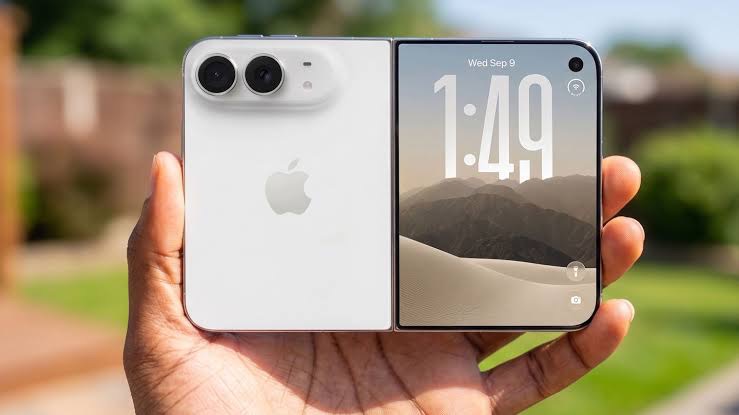
Apple’s long-rumored foldable iPhone is officially real, on sale, and already difficult to buy.
The iPhone Duo launched in stores on October 23, 2026, after pre-orders opened on October 16. It starts at $1,999 for the 256GB model and jumps quickly with higher storage options — $2,199 for 512GB, $2,599 for 1TB, and $3,199 for 2TB. Demand was intense from the start. Many configurations sold out fast, Apple Stores only have limited walk-in stock, and some delivery estimates are already stretching into January 2027.
This is Apple’s first real swing at a foldable phone after years of watching Samsung, Google, and others iterate. The result is a polished but imperfect device that feels distinctly Apple in some ways and still first-generation in others.
Design and Build: Premium, Dense, and Different
The Duo uses a book-style design. Closed, it has a somewhat unusual passport-like proportion — wider than a typical iPhone and shorter. Open it, and it becomes a much larger tablet-like device.
Key numbers:
- Folded: 11.3mm thick
- Fully open: just 5.2mm thick (Apple’s thinnest iPhone yet)
- Weight: 254 grams
That weight is noticeable. It’s heavier than a standard iPhone 18 Pro Max, and several reviewers have mentioned it can feel tiring during long one-handed use. The trade-off is a very solid, premium feel. The frame is Grade 5 titanium, the hinge is refined, and the phone carries an IP68 rating for dust and water resistance.
Most people who’ve handled it praise the hinge. It feels precise, stays open at different angles, and the crease on the inner display is subtle — especially compared to earlier foldables. The overall build quality is consistently called out as one of the strongest points of the device.
Colors at launch are Night Sky and Star White.
The Screens: The Star of the Show (With One Clear Weakness)
The Duo has two displays:
- Outer cover screen: 5.4-inch Super Retina XDR OLED, 120Hz ProMotion
- Inner folding screen: 7.6-inch Super Retina XDR OLED, also 120Hz ProMotion, with a matte nano-texture finish
The inner display is the part almost everyone loves. The matte finish reduces glare and makes the crease much less obvious than on glossy foldable screens. Brightness is strong (up to 3,000 nits peak), and the panel feels premium for reading, multitasking, and media.
The outer 5.4-inch screen is the most common complaint. It’s usable for notifications, quick replies, and basic tasks, but it feels cramped compared to a regular modern iPhone — especially once the keyboard comes up. Several reviewers said they found themselves opening the phone more often than expected just to get a comfortable view of content.
Performance, Battery, and Everyday Feel
Inside is the same A20 Pro chip found in the iPhone 18 Pro models. Early performance impressions are strong. There’s no sense that Apple compromised on silicon to make the foldable work. Multitasking, app switching, and general responsiveness feel on par with the current Pro phones.
Battery life has also been better than many expected for a first-generation foldable. Apple uses a dual-battery design and rates the phone for up to 44 hours of video playback on the outer screen and around 31 hours on the inner display. In real-world testing, reviewers have generally reported solid all-day battery with some left over, even with mixed use of both screens.
One notable change from recent iPhones: there’s no Face ID. Instead, Touch ID is built into the side button so it works whether the phone is open or closed. Some people adapt quickly. Others miss Face ID more than they expected.
Cameras: Good Enough, But Not Pro-Level
This is one of the clearer compromises. The Duo has a dual-camera system on the back: a 48MP main and a 48MP ultra-wide. There’s a limited telephoto option, but it doesn’t match the zoom range or versatility of the iPhone 18 Pro models.
For everyday photos and video, it’s competent. If photography is a major reason you upgrade phones, the regular Pro models still have a clear advantage. The under-display front camera on the inner screen also draws mixed reactions — functional, but not as clean as a traditional punch-hole or Dynamic Island setup.
Software: Promising, But Not Fully Ready
iOS on the Duo takes advantage of the larger canvas for multitasking, split views, and a more tablet-like experience when open. Apple has clearly put work into making the transition between the two screens feel natural.
The bigger issue right now is third-party apps. Many popular apps still aren’t fully optimized for the unfolded 7.6-inch display. Some look stretched, others don’t take advantage of the extra space, and a few still feel awkward. This is the classic first-generation foldable problem, and most reviewers expect it to improve over the next several months as developers update their apps.
What Reviewers Are Saying
The early consensus is fairly consistent:
The good
- Excellent build quality and hinge
- Impressive matte inner display
- Strong performance and battery life
- Feels more refined than most first-gen foldables
The not-so-good
- Small cover screen
- Missing Face ID
- Camera system trails the Pro models
- High price
- Apps still catching up
- Noticeable weight
Some outlets call it the best foldable they’ve tested. Others describe it as a fun, expensive early-adopter device that isn’t quite ready to replace a regular iPhone for everyone.
Who Should Actually Buy One Right Now?
The iPhone Duo makes the most sense if:
- You’ve been waiting specifically for Apple’s foldable
- You value a large, high-quality screen for reading, media, and multitasking
- You’re okay being an early adopter while apps improve
- The $2,000 starting price doesn’t feel painful
It’s a weaker fit if:
- You mainly want the best cameras
- You rely heavily on Face ID
- You prefer a lighter, more traditional phone
- You want maximum practicality for the money
In many ways, the regular iPhone 18 Pro or Pro Max is still the smarter daily driver for most people. The Duo is the more interesting and ambitious device — just not the most practical one yet.
Bottom Line
Apple finally entered the foldable market with a device that feels considered rather than rushed. The hardware is strong, the inner display is excellent, and the overall experience is more polished than many expected from a first attempt. At the same time, the compromises are real: the price is high, the cover screen is small, Face ID is gone, the cameras aren’t class-leading, and the software ecosystem still needs time.
If you’re the kind of person who wants the newest form factor and doesn’t mind living with a few early rough edges, the iPhone Duo is one of the most compelling phones Apple has released in years. For everyone else, it’s an impressive piece of engineering that will probably get better — and easier to recommend — over the next year or two.